Exterior paint colors - how to choose one and see it on your house
The expensive way to choose is to buy five gallons and find out on the wall. This page works the other way round: start from the roof, brick and stone you are not changing, test the finalists on two walls, and look at your own house in a new color before the first can is opened.
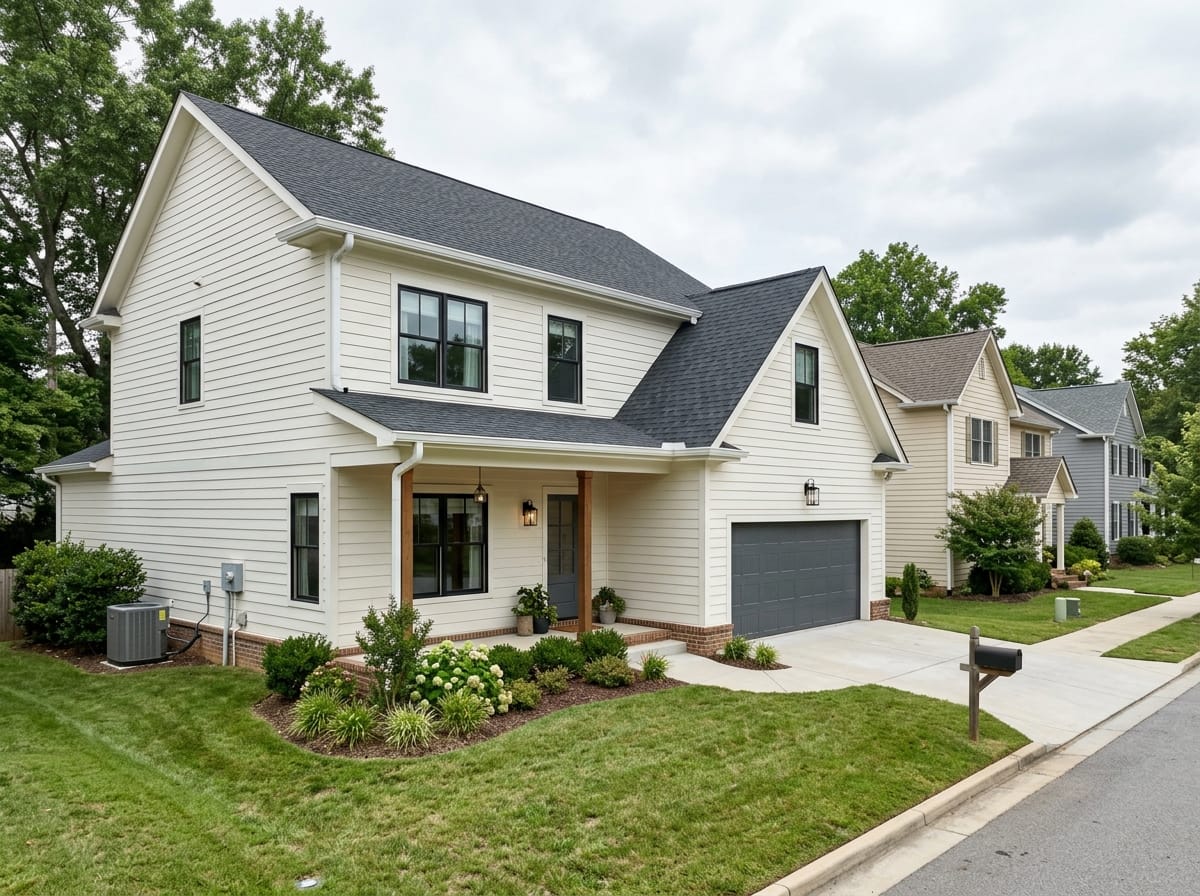
Where an exterior color is actually decided
An exterior color is never really chosen on a wall of chips. It is chosen by the parts of the house nobody is replacing: the roof, the brick or stone at the base, the chimney, the driveway. Those hold their color for decades and set the temperature of the whole scheme. The paint has to join them, not argue with them.
Second comes light. The same gallon reads warmer on the south side and colder on the north, and both readings are honest - which is why a color that looked settled in the store can turn green, pink or muddy once it is on the house.
Taste comes third. Reverse that order and you get the familiar ending: a beautiful shortlist, a finished house that is slightly off, and a fix that costs another five gallons and another long weekend.
General questions about redrawing a house exterior live on the /en/facade-design hub. This page stays on color: what fixes it, how to test it honestly, and how to look at your own house wearing it.
Start with what you are not changing
Four things on a typical American house outlast the paint by a wide margin. Read them first and the shortlist writes half of itself.
After the walls, the roof is the largest block of color in every photo of the front of the house, and asphalt shingles are rarely neutral. Shingles sold as gray are often brown, violet or green once the sun is on them, and a warm shingle will quietly ruin a cool gray body.
- Judge the shingle in daylight, not by the name on the bundle
- Hold every sample at the roof edge, where the wall and the roof actually meet
- A roof replaced in the last few years is setting the scheme for the next couple of decades
What light and orientation do to the color
Exposure is the second input after the fixed materials. A wall in full afternoon sun and a wall that never sees direct light are two different colors out of the same can.
| Where and when | What happens to the color | What to do about it |
|---|---|---|
| South wall, midday | Full sun washes the color out by a shade or more and flattens it. Saturated colors go pale, whites glare, and texture disappears | Test here first: a color that survives midday sun survives everywhere else on the house |
| North wall | Never gets direct sun and drifts cool. Grays go blue, greige goes gray, warm whites lose the warmth you chose them for | If you want warmth, take it from the warm end of the family - the north wall will remove some of it for you |
| East wall in the morning, west wall late in the day | Low sun hits at an angle and adds orange. The same wall is not the same color at 8 am and at 6 pm | Look at the same patch twice in one day, once early and once late |
| Overcast sky | Saturation drops and undertones step forward. This is when a beige shows its pink and a gray shows its green | Overcast is the honest test - through much of the year this is how the house is seen |
| Under trees or against a lawn | Foliage bounces green onto the wall all summer, and neutrals pick it up readily | Test on the shaded side too, and look at the same color again in winter light |
| Snow on the ground | Reflected light from below raises the whole wall and flattens light colors against a white yard | In snow country, check that a pale body still has an edge against the roof and the trim |
Two walls, three times of day
One patch on one wall proves nothing. Put the same color on a sunny wall and a shaded wall, then look at both in the morning, at midday and on a gray day. The gap between those two walls is usually a full shade - wide enough to change your mind.
How to test a color before you buy the paint
Sample pots and peel-and-stick samples both do the job. What decides the outcome is where you put them and what you look at them next to.
Paint patches about 8 x 8 in, not brush swatches
Anything smaller gets swallowed by whatever surrounds it. Two coats, so you are looking at the color and not at the old siding showing through.
Put the same color on at least two walls
One sunny, one shaded. If a color only works on one of them, it is the wrong color for this house, however good it looked in the aisle.
Never judge a patch floating in bare siding
Chalky old siding makes everything next to it look bright and clean. Place the patch where it touches the trim, the roof edge or the brick - the things it has to live with.
Move the sample around the house
Peel-and-stick samples let you carry one shade to the chimney, the garage door, the porch ceiling and the shaded corner in a single afternoon without painting the house four times.
Look from the street, not from arm's length
The house is seen from the sidewalk and from a moving car. Walk to the curb, look back, and see whether the patch still reads the way it did up close.
Check it wet and check it at dusk
Rain darkens siding, and low evening light pulls undertones out. A color you have only seen in Saturday sunshine is a color you have seen once.
Exterior color families and how they behave outdoors
No paint codes here on purpose: every deck mixes its own version of the same name, and a code copied from an article is worth nothing on your wall. These are families, and what each one does once it is outside in daylight.
| Color family | What it pairs with | How it behaves outside |
|---|---|---|
| Warm white and soft white | Black or bronze windows, dark shutters, a dark roof, natural wood on the porch | Has almost no color of its own outdoors: it takes blue from a midday sky and gray from cloud. Shows pollen, road film and mildew faster than anything else here |
| Greige - gray over a warm base | Nearly any shingle, warm brick, stone, white trim | The most forgiving body color on a mixed street. In deep shade it can go flat, and texture rather than color is what rescues it |
| Cool gray | Gray or black roofs, white or black trim, stone with a gray cast | Fights brown shingles and warm brick openly. Under trees in summer it pulls green out of the lawn |
| Cream and light beige | Clay tile and brown roofs, wood, wrought iron, copper | Holds warmth even under a gray sky and turns buttery at sunset. Comfortable with everything in the brown family |
| Sage and muted green | Dark brown or weathered wood roofs, stone, cream trim | Dissolves into the yard in summer and steps forward against bare branches and snow. Read it in both seasons before you commit |
| Navy and deep blue | White trim, gray or black roofs, brick with a cool cast | Reads nearly black in shadow and shows its blue only in direct sun. Loses pigment faster than a light body color |
| Charcoal and near-black | White or wood trim, pale stone, light hardscape | In backlight the texture vanishes and only the silhouette is left. It is also the hottest wall on the house in summer |
| Clay and terracotta | Clay tile and brown roofs, cream trim, stone, iron | Lives on sunlight: under a gray sky it slides toward brick-brown and loses its life |
Body, trim and accent: the three-color rule
Three colors is the working limit on a house exterior, and the roof counts as one of them. Proportion matters more than the shades themselves: the body carries most of what you see, the trim frames it, and the accent shows up once.
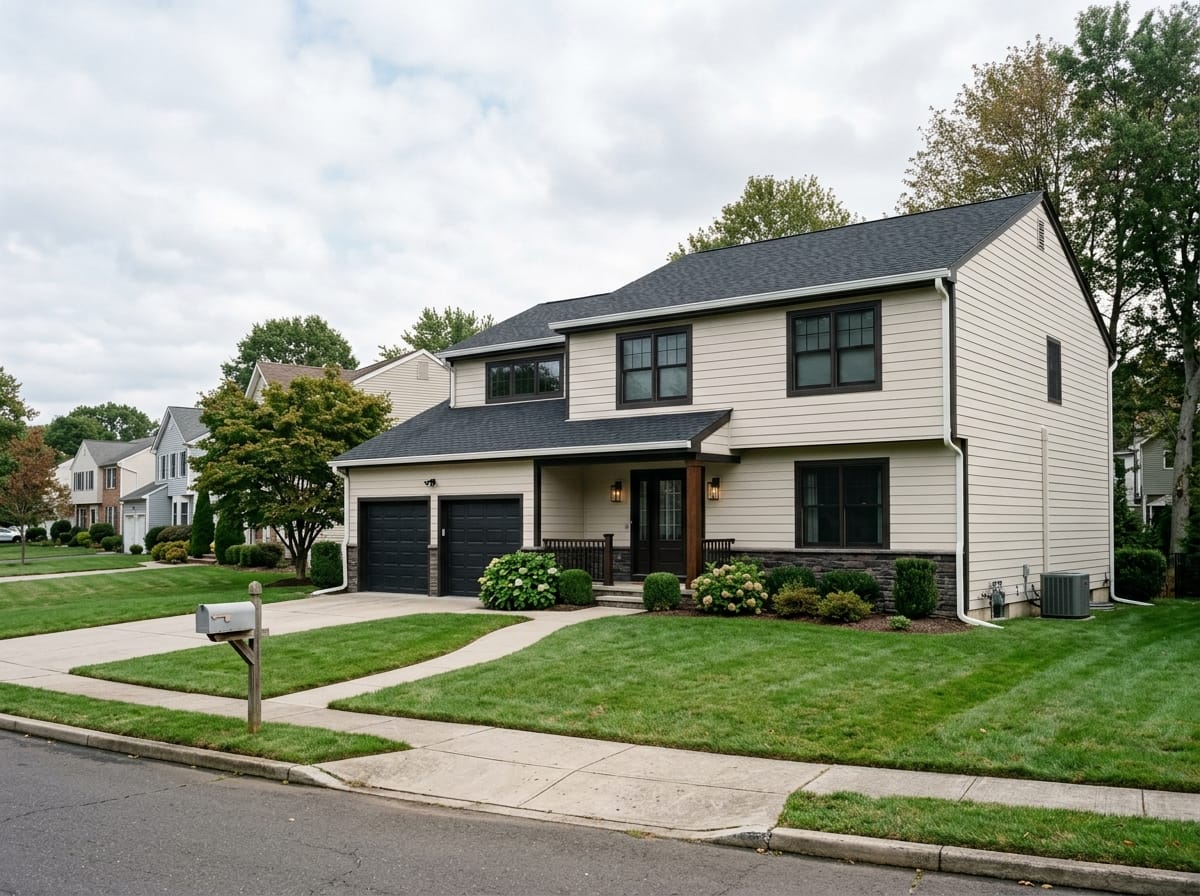
Light body, dark roof, dark windows
A pale body, a charcoal or black roof, dark window frames and a dark base. The eye finds every edge immediately and the house reads as assembled even with very little detail. This scheme forgives an imprecise shade, because what carries it is the gap between light and dark rather than the exact color.
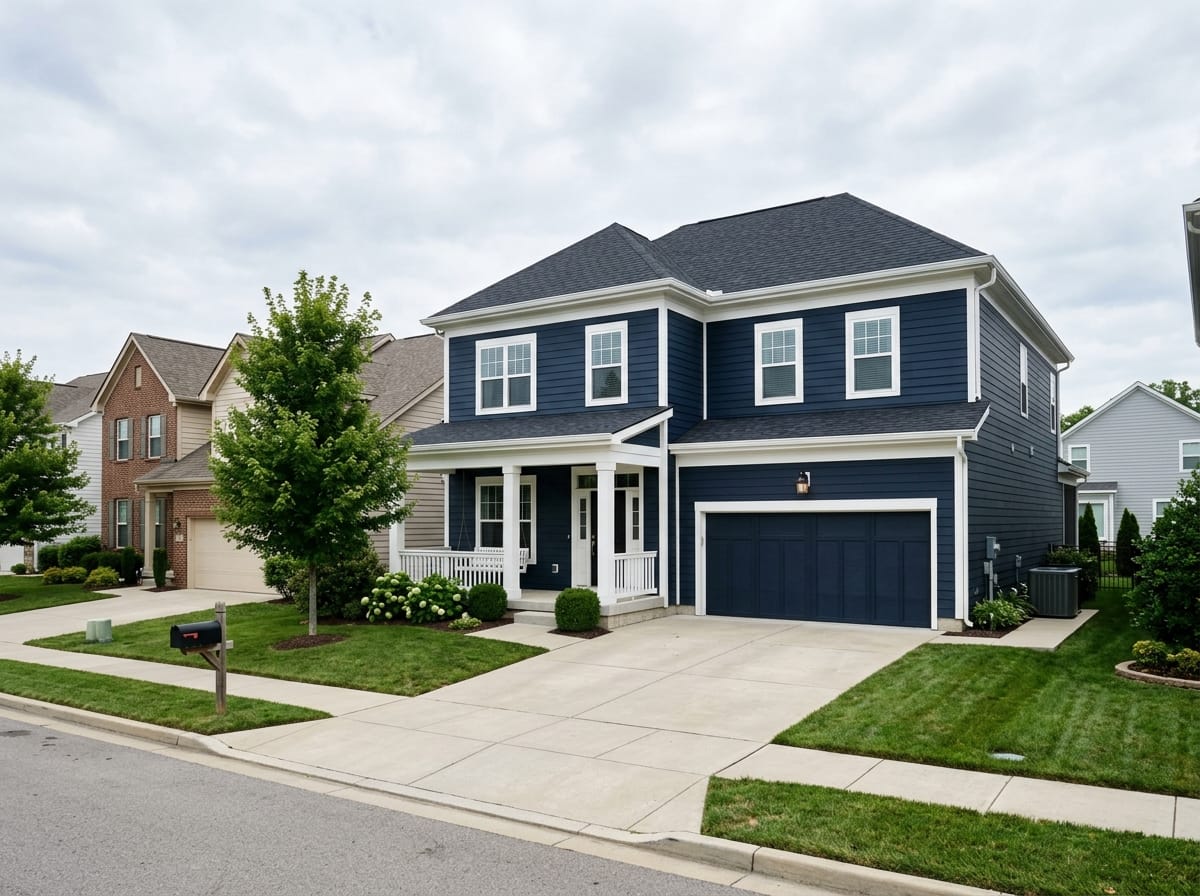
Dark body, white trim
A charcoal, navy or deep green body with crisp white casings, a white frieze board and white porch posts. The trim is doing the structural work here: without it, a dark house loses its windows and corners after dusk. Simple house shapes carry it easily; an elevation full of returns and bump-outs turns into one dark mass.
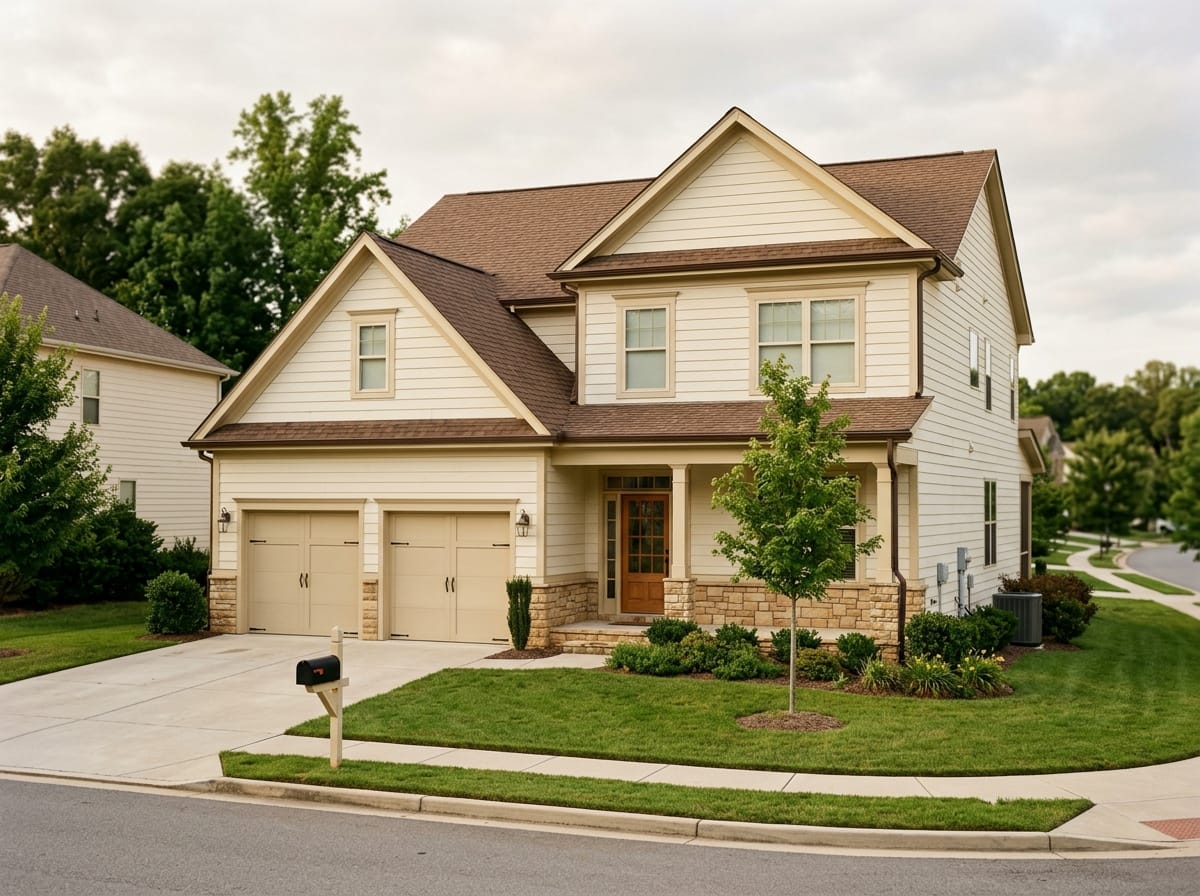
Warm monochrome
A cream or beige body, trim half a shade lighter, a brown or clay roof, and stone at the base. Contrast comes from the shadow each piece of trim casts rather than from color. There is one mistake available and it is fatal: drop a cool gray into a warm scheme and it reads as dirt.
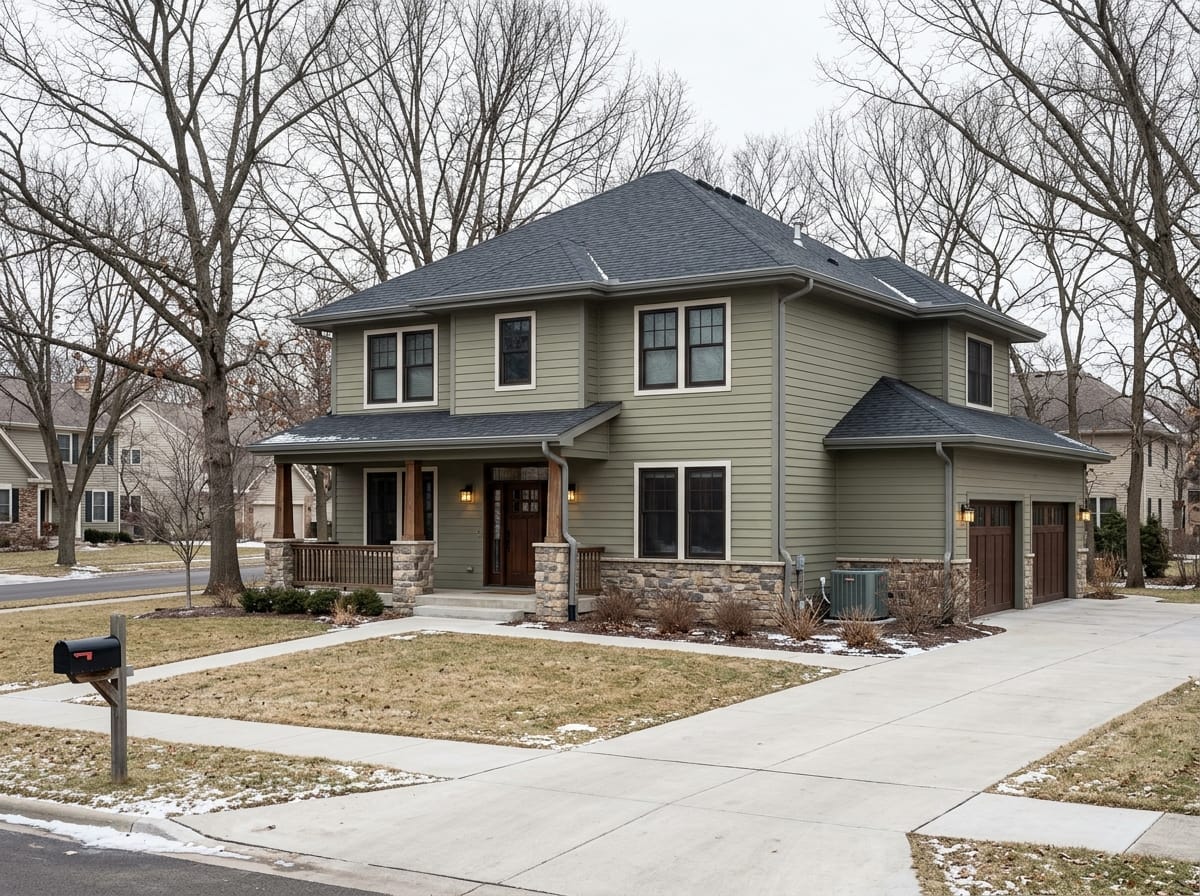
Colors taken from the lot
A sage or olive body, a dark brown roof, deep green or bronze windows, wood on the gable and the porch. The house settles into the site instead of announcing itself. Check this one in winter: what disappeared into the trees in July comes forward against bare branches in January.
Trim, shutters and the front door
Trim is a line, not a color
From the street, trim is not really a block of color - it is an edge with a shadow under it. That is why the direction matters more than the shade: on a warm light body, trim goes lighter than the wall; on a cool light body, trim goes darker. Mixing both moves on one house leaves it looking undecided.
White trim on a dark body is the most forgiving combination available, and it is the reason dark houses photograph well. The width helps too: a narrow casing disappears at any distance, while a wide casing and a real frieze board give the house a drawn outline.
- One trim color for casings, corner boards, the frieze and the porch - not three
- Porch ceilings can go lighter than the trim without counting as a fourth color
- Putting the accent color on the trim is almost always a mistake: it outlines the house instead of framing it
The door and the shutters carry the accent
The front door is the one place a saturated color is safe, because it is small, it is framed and it is easy to change. Shutters are the opposite: there are a lot of them, they repeat across the whole front, and a third color on them turns the elevation into stripes.
So the accent appears once. Either the door carries it and the shutters stay with the trim or go dark, or the door and the shutters share it and nothing else on the house does.
- Test a door color with the storm door, the screen and the house numbers in front of it
- Shutters in a color that is neither the trim nor the body read as an accident
- A wood or stained door counts as an accent, so a painted accent elsewhere becomes a fourth color
Dark exterior colors and what the sun does to them
Charcoal and black houses have been the most requested look for several years now. They come with physics attached, and it is cheaper to know about it beforehand.
- They run hot — A dark wall in full sun gets far hotter than a light one. On vinyl siding that is not a comfort issue: standard vinyl can warp, and manufacturers commonly set a lightness limit below which the warranty stops applying. Ask the siding manufacturer before the color is ordered, not after.
- They fade first, and unevenly — Deep colors carry more pigment and lose it faster, starting on the south and west elevations. Within a few years the difference between the sunny side and the shaded side of the same house can be visible from the street, and the fix is repainting the whole thing.
- They erase texture and leave the silhouette — Dark paint flattens lap lines, board edges and shadow. On a clean shape that looks deliberate. On a house with a lot of bump-outs, returns and roof planes it turns into one unreadable mass.
- They need light trim to stay legible — Without contrasting casings and corner boards, the windows and the corners disappear at dusk and the house stops having a front. The trim is what keeps a dark scheme from collapsing.
- Touch-ups show — A repair patch in a deep color rarely blends. Keep leftover paint from the same batch, sealed and labelled with the elevation it came from.
What you are painting over
The same color on siding, stucco, brick and wood produces four different results, and one of them is a one-way door.
Fiber cement takes paint readily and holds it, which is why most of it arrives factory-finished - and a factory finish outlasts a field repaint by a wide margin. Vinyl can be repainted with products made for it, but only within a lightness limit, and the lap pattern stays visible whatever color goes on top.
- A factory finish is worth keeping if the color is anywhere near acceptable
- On vinyl, check the darkness limit before you fall in love with a charcoal
- Lap shadows make a body color read a half shade darker than the patch did
The street, the HOA and the historic district
In much of the country the color is not entirely yours to choose, and the cheapest moment to discover that is now.
- The HOA architectural committee — Plenty of neighborhoods require written approval before an exterior repaint, work from an approved palette, and limit how many houses on one street may carry the same scheme. Submitting takes a form and some weeks. Repainting under a violation notice takes a summer. What any particular committee will approve is theirs to decide - read your own covenants and ask them first.
- Historic districts — If the house sits in a locally designated historic district, review can extend to the body, the trim, and occasionally the sheen and the number of colors. The rules come from the local commission, and they are not the same from one town to the next.
- The street itself — Walk the block and photograph it, including the houses either side and the one across the road. A single high-contrast house on a restrained street draws a kind of attention that is not always welcome when it comes time to sell.
- Your own outbuildings — The garage, the fence, the shed, the mailbox post and the porch rail are in the same picture. Whatever you choose has to survive being repeated on all of them, or the yard ends up as a collection of near-misses.
- Shared walls and matching rooflines — In townhouse rows and duplexes the adjoining unit is in your sightline and you are in theirs. A color that reads as personality on a detached house reads as a mismatch where the rooflines run on.
Exterior color schemes on whole houses
These are model-generated reference frames rather than photographs of finished projects. They are here to show how a scheme reads across a whole elevation - the exact shade on your wall is still settled with sample patches.
Light body with a dark roof
Pale warm white walls, charcoal shingles, black windows, wood on the porch. The scheme that forgives the most and photographs well on almost any house shape.
Make one like this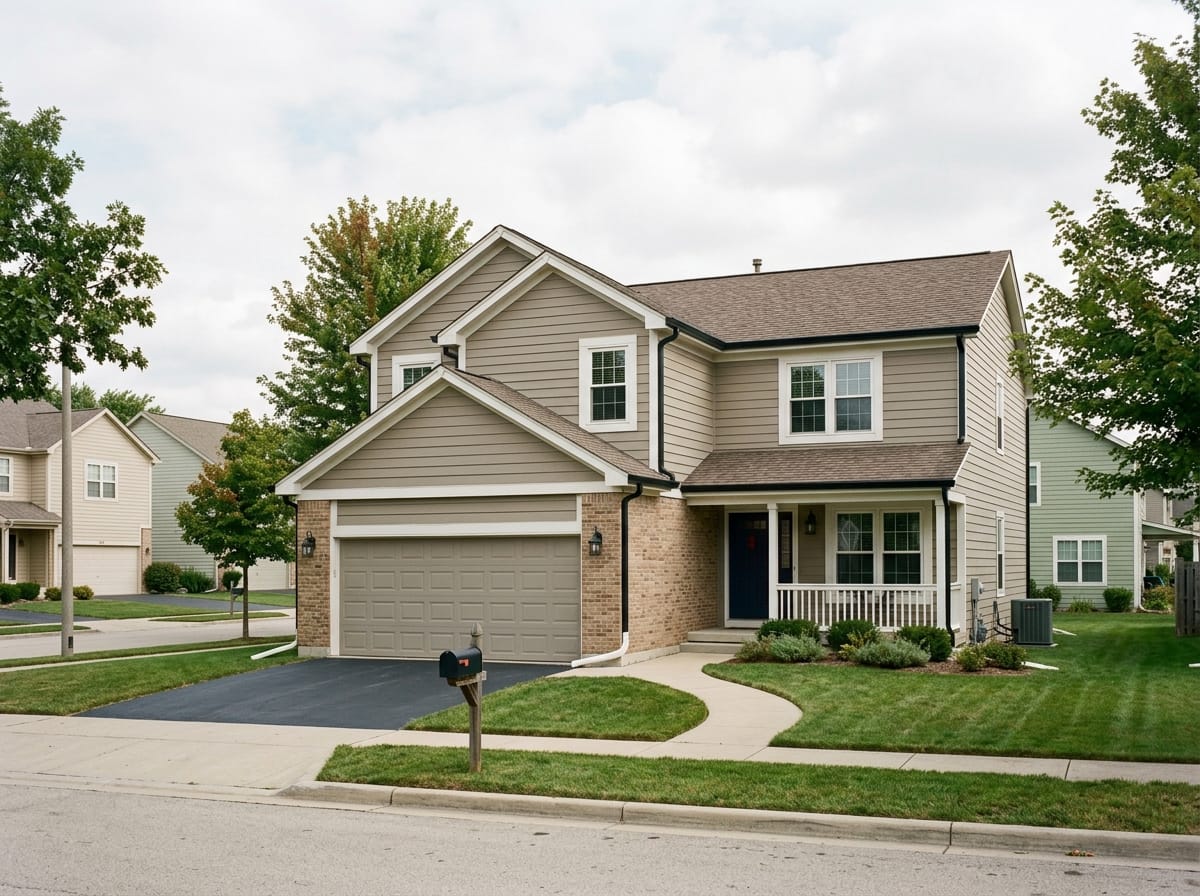
Greige with white trim
A gray with a warm base, white casings and corner boards, a brown shingle roof. The quiet option that stays on speaking terms with a brown roof and warm brick.
Make one like this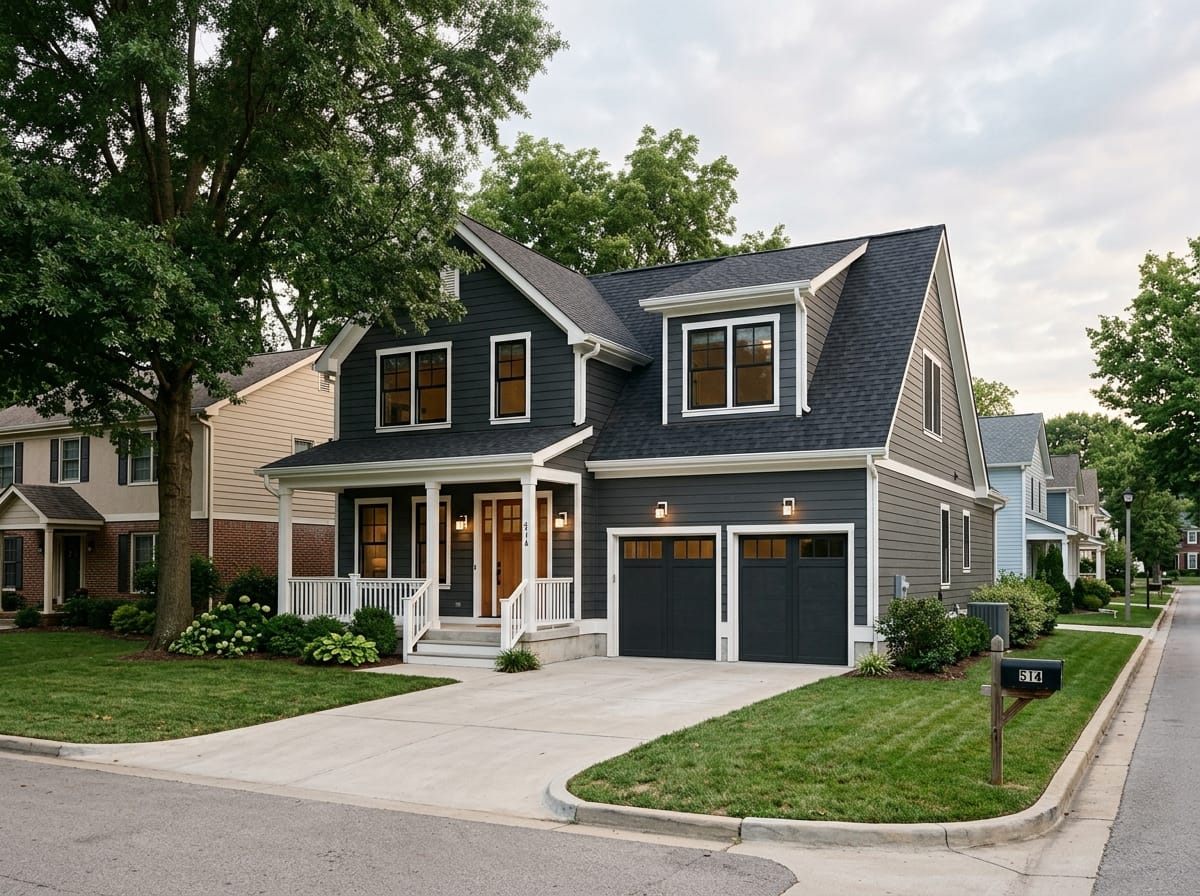
Dark body, crisp trim
Charcoal siding, white casings and rails, a stained wood door. Works on simple shapes and asks for light trim to keep the windows visible at dusk.
Make one like this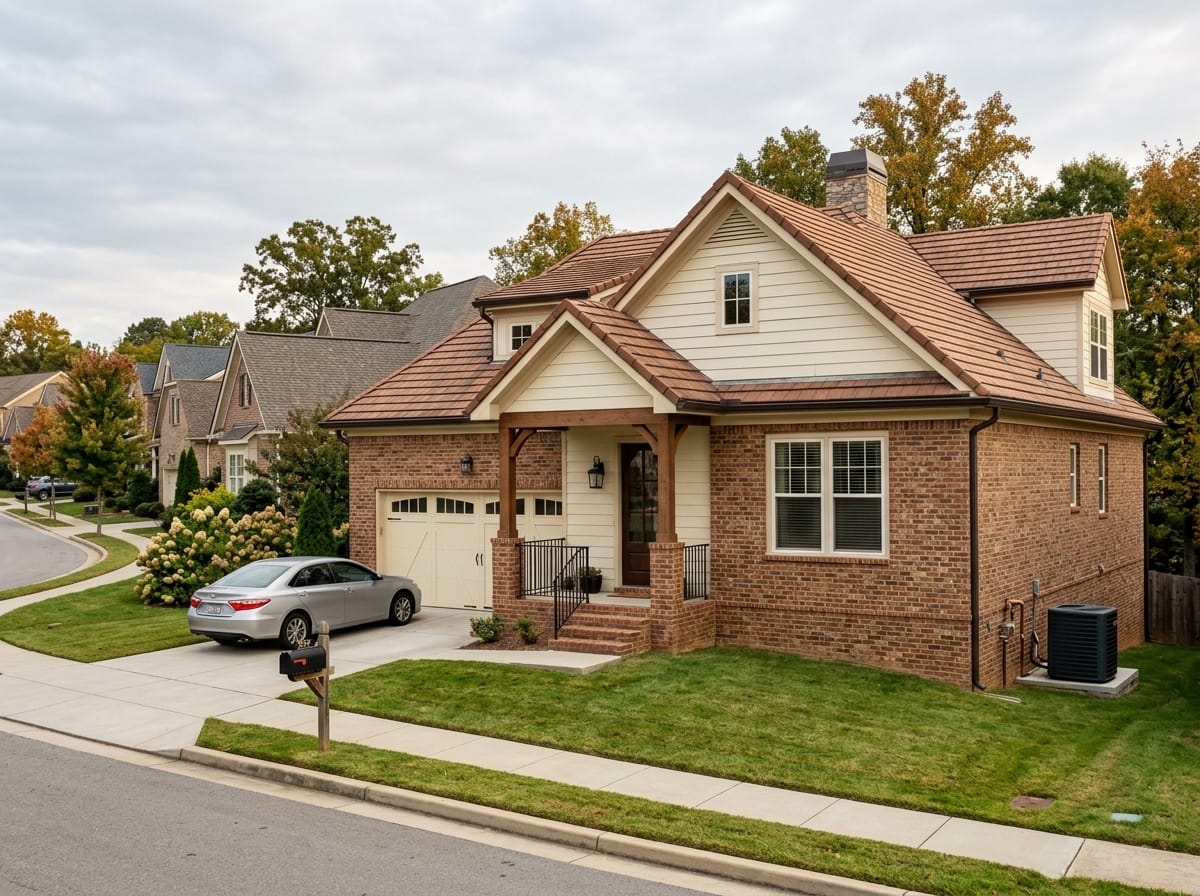
Warm scheme on brick
Cream body above a brick base, clay roof, iron rails. The masonry sets the temperature and the paint stays inside it.
Make one like thisSee it on your own house in three steps
It runs in a browser, on a phone or a laptop. What comes back is a redrawn photograph of your house - not a drawing, not a plan, and not a paint order.
Photograph the house from the street
Stand across the road or at the end of the driveway so the whole front is in frame, with the roof edge and any brick or stone visible. Daylight, no strong backlight. JPG, PNG or WEBP up to 10 MB - HEIC files straight off an iPhone need converting first.
Choose a style - up to two per run
Ten styles come as tiles: Minimalism, Classic, Scandi, Neoclassical, Loft, Contemporary, Black-tech, High-tech, Chalet, Barnhouse. Each carries its own palette and materials, so the choice sets a direction - light and calm, or dark and graphic. There is no free-text field, so you are choosing a look rather than naming a shade.
Look at the result the way the street sees it
You get your own house, with its roof, its proportions and its masonry, wearing a different exterior. Download is open immediately: Standard at 1024 px on the long side, Pro at 2048. Run the same photo through a second style to hold two directions side by side.
What this step does and does not do
The tool shows how a direction sits on your own roofline: where the contrast lands, whether dark suits the shape of the house, how light reads against your roof and brick. It does not mix paint and it cannot be told a specific shade. Use it to get from ten candidates down to two, then settle the shade with patches on the wall.
Before the first gallon
Everything above is easier to judge on your own roofline than on a chip taped to the siding. A new account comes with two free exterior designs; signing in is required.
Before the first gallon
Everything above is easier to judge on your own roofline than on a chip taped to the siding. A new account comes with two free exterior designs; signing in is required.
When to paint, and how far a gallon goes
Two things set the schedule: what the surface temperature does overnight, and how much wall a gallon actually covers on your siding. Both are wider than the label suggests.
| Question | What to work from | Where it goes wrong |
|---|---|---|
| When in the year | Late spring through early fall across most of the country, with the dry window shifting by region - earlier in the Southwest, later in the Pacific Northwest, around the humidity on the Gulf Coast | Pushing into the first cold nights of fall, when the wall is colder than the air long after sunset |
| Temperature | Most exterior paints want the surface and the air above 50°F through the whole drying window, and low-temperature formulas state their own lower range on the can | Reading the afternoon air temperature and ignoring what the wall does overnight |
| Time of day | Follow the shade around the house so you are never rolling a wall in direct sun | A hot wall flashes the paint off before it can level, and the finish keeps every lap mark |
| How much paint | Roughly 250-400 sq ft per gallon per coat on smooth siding, and noticeably less on stucco, rough cedar or bare masonry | Buying by the label figure on a textured wall and running short halfway up an elevation |
| Batch consistency | Order the body color in one go, mixed at the same time, and box the cans together before starting | Topping up weeks later: the same name from a new batch can land slightly off, and a long wall shows it |
Dark colors where the sun is direct
Through the Southwest and along the Gulf Coast a dark wall bakes all afternoon, which shortens the life of the finish and, on vinyl, puts the siding itself at risk. Where the sun is that direct, dark usually belongs on the trim, the shutters and the door rather than on the whole body.
Eight ways an exterior color goes wrong
Almost every story that ends with repainting two years later starts in this list. All of it is solvable before the purchase and barely solvable after.
Choosing off the fan deck in the store
A chip is read from a foot away under store lighting; the house is read from the street in daylight. Fluorescent and LED fixtures shift undertones, which is why the beige that looked warm in the aisle turns pink on the wall.
Choosing off a screen
Every monitor and every phone renders color differently, and no photo on the internet matches the paint it is labelled with. Screens are useful for narrowing the field and useless for making the final call.
Picking the body color first and making the roof cope
The roof is the expensive one and it is staying. Fix the roof, the brick and the stone in the scheme first, then choose the body around them - the reverse order is what makes a house look accidental.
One patch, one wall, one hour
The north side and the south side sit a shade apart, and cloud moves both. A color approved in a single look on a sunny Saturday is a color you have not really seen yet.
A fourth and a fifth color
Body, trim and one accent, with the roof counted in. Every extra color breaks the house into pieces when you look at it from the sidewalk.
Roof and body at the same lightness
A medium gray roof over a medium gray body gives the eye no edge to land on, and the result reads as smudged rather than subtle. Keep a clear step in lightness between the two.
Rolling in the heat of the day
Direct sun on the wall while you are painting it is the common cause of lap marks and patchy sheen, and chasing the shade around the house costs nothing but planning.
Assuming nobody will mind
Covenants, an architectural committee or a historic district review can all sit between you and the color you picked. Finding out after the second coat is the most avoidable version of this whole list.
Exterior paint color questions
Can I see a color on a photo of my own house?
Does it take my roof into account?
Does this replace sample patches on the wall?
My house is brick. Can I just paint it?
What if my neighborhood has an HOA?
How many free tries do I get?
What color goes with a brown roof?
Should the trim always be white?
Is a dark exterior a bad idea?
What kind of photo should I upload?
Upload a photo of your house
Two exterior designs are free on a new account. Pick up to two styles per run and look at your own roofline in a different color before the first gallon is bought.
See my house in a new color